Translate

Showing posts with label east coast. Show all posts

05 May 2013

Flooding in the Last Five Years: 2010

About a week ago I put up the first post in a series of five about flooding. That one was titled Flooding in the Last Five Years: 2009 and recapped the major flooding events that year. I also gave the total cost of damages and lives lost do to flooding. There were about 8 major events, with 51 deaths and just over a billion in damages that year.

Now, let's take a look at what the year 2010 brought us, in terms of flooding. I am pulling information from a yearly report provided by The National Weather Service/NOAA. There you can find more information about the year and each of the events.

2010

  • March: Flooding in much of the Northeast due to an early thaw. First, in parts of New Jersey, Connecticut, Rhode Island and Massachusetts the snow melted right before a large rain storm. This over saturation caused flooding. Then a couple weeks later the snow in New Hampshire and Vermont melted, this added more water to already swollen rivers in Massachusetts. This month saw some serious flooding, especially in New Jersey's Passaic River Basin.

    The damages for the month totaled $330 million over the four states. Amazingly, there were no flood-related deaths.


  • May: Heavy rainfall causes flooding in Tennessee and Kentucky. Rainfall records were broken, and many rivers also rose to record heights. This flooding cost $2.3 BILLION and 26 lives were lost.
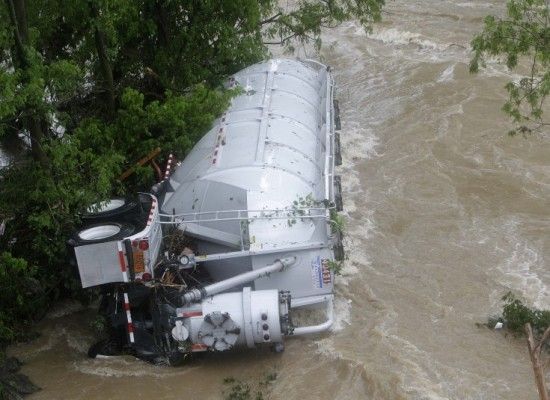
A tanker truck is pushed against trees after being washed away, 
Sunday, May 2, 2010 in Nashville, Tenn.
 (AP Photo/Mark Humphrey)


  • June: Flash flooding due to storms in Texas and Arkansas. This flooding caused towns to be evacuated in Texas. In Arkansas, campers by the Little Missouri River were wakened by flash flooding. This was another deadly event with 20 deaths and 26 people injured. This storm cost $9 million in damages.

    A second flooding event occurred in June, when a storm dumped heavy rains on Oklahoma City. The timing of the storm during and right before rush hour caused many vehicles to become stuck in the waters. There were 130 injuries, one death and and about $6 million in damages.


Search for Flood Survivors
Photograph by Sue Ogrocki, AP


  • July: The first of four flood events this month was in Alaska. Flooding from a storm caused washouts and mudslides. In Alaska, flash floods are rare, but they did occur with this storm. One person lost his or her life. The report did not list the amount of damages associated with this particular event.

    The second episode of flooding occurred in Iowa. Technically, the event started in June with many heavy rain storms. So, in late July, the ground couldn't hold any more water and the next round of storms caused flooding. This severely damaged the corn and soybean crop. There were no deaths or serious injuries reported, but there was about $50 million in property damages and an estimated $1 billion in agricultural damage.


Then, in Wisconsin, again the rains in June set up the scenario where the rains in July couldn't be absorbed, leading to flooding there as well. There was one death reported and about $27.7 million in damages.

The fourth notable flood event in July occurred in Texas along the Rio Grande. It started with the remnants of Hurricane Alex, and then Tropical Depression #2 pushed the river over the edge. The flooding lasted for about the entire month of July! The President declared many counties in the Rio Grande Valley as areas of Major Disaster. There were three deaths and over $110 million in damages.

KXAN - Jim Spencer/blog
  • September: Flooding in Texas and Oklahoma occurred due to Tropical Storm Hermine. There was $29 million in damages and six deaths.


  • September/October: Remnants of Tropical Storm Nicole met up with a low front, which led to intense rainfall and flooding along the Eastern Seaboard. It affected North Carolina's mainland and Outer Banks, the Catskills of New York, and parts of Pennsylvania. This storm also caused damage to crops, so the totals were $20 million in property damages, $70 million in agricultural damages and seven fatalities.


Well, looks like another bad year for flooding! Unlike 2009, we saw some serious flooding due to tropical storms.

So let's review the totals! Using the same chart as in the last post, provided in the report by the NWS, there were a total of 112 flood-related deaths and $5,041,227 in damages.

The amount in damages in 2010 was over 5 times the amount in 2009! And, over double the amount of fatalities!

Yikes!

Next in this series of posts we will examine 2011 in this same format. I know 2011 saw Hurricane Irene...

Then there was Hurricane Sandy in 2012, but Water Year 2012  runs October 1st 2011-September 30th
2012, so Hurricane Sandy will actually be included in the 2013 Water Year evaluation.

Looking ahead makes me think that these numbers are going to get worse, before they get better.

So, stay tuned for the third post in this five-part series about Flooding the the Last Five Years.


14 April 2013

The 100 Year Flood

With the intense storms and flooding that have been experienced lately people are talking more about 100 year events. There are other number events too, such as 10 year, 50 year, and 500 year events. These events can be floods or storms, like a 100 year flood.

I first heard these terms a couple years ago while taking an emergency management course. We were talking about flooding at the time. We learned in class that the number, 100, 50, etc, actually refers to the statistical chance that the event will occur every year. So, a 100 year flood means that every year there is a 1 in a hundred, or 1%, chance that a large scale flooding event will occur. If there is a 1 in a hundred chance that the flood might occur, then one should happen about every 100 years. I found a great image, see below, that helps illustrate the water levels and occurrences of the different events.

Ohio Department of Natural Resources

According to FEMA in their handout titled The 100 Year Flood Myth all different levels of flooding occur and can come with their own label. Lesser floods will most likely occur more often and be labeled 1 year floods or 5 year floods. As the floods grow in intensity the likely-hood of them occurring decreases. So, a 50 year flood won't be as bad as a 100 year flood but is twice as likely to occur. However, the handout points out that floods occurring every couple years, or even every ten years, will end up doing more damage then a flood that occurs only once every 100 years.

The other interesting point made in the handout is that the term 100 year flood is being used more frequently than it should. Not every flood is a 100 year flood! The term sounds good, and catches peoples attention, so the press like to use it. It may seem like 100 year floods are occurring more than they should, but that is most likely due to the floods being mislabeled.
By using the term “100 year flood” inaccurately to describe
floods that are actually much lesser floods, the misconception is
spread that 100 year floods are occurring every few years! In
fact, floods close to this are occurring, but they are only 5 or 10
year events that look so similar to the “big one” that they get
labeled with the same name. This misapplication of the 100 year
term leads to misplaced criticism of the analysis that produced it
and of those engineers who generated it.
Floods are very important to understand, as they can cause a lot of damage. I know people who live by me don't expect flooding and are not prepared for it. I certainly am not. 

When Hurricane Sandy hit New Jersey and New York we were horrified, and still are, at the devastation that the flood waters caused.

PHOTOS: Hurricane Sandy Wipes Out Seaside Heights


Here's The Jersey Shore Devastation That Made
Chris Christie Get So Emotional


I remember seeing the damage that Hurricane Irene caused in Vermont. It was horrible. 

Who would have imagined that flooding in Vermont? 

Massive snowstorms, sure. 

Ice storms... remember the Ice Storm of '98? 

I sure do. But flooding? 
From Waterbury to Wilmington,
Vermonters shocked by Irene's destruction
Photos from The Republican


Flooding always seemed an event reserved for people living by the Mississippi River, in Florida, or New Orleans. The Northeast sure got a rude awakening. 

With climate change leading to more intense storms, will there end up being an adjustment to the 100 year floods?

It is definitely something worth watching.

There is a lot more to discuss about flood waters and flood safety. I might even take a look at flood insurance. So check back soon for more information on this topic!


03 February 2013

The Nor’Easter Ate My Homework!

All of us living on the east coast have experienced many a winter storm.  Some of the worst, or rather many of the worst, we have called a Nor'easter.  But, what exactly is a Nor'easter and why are they so severe?


According to The Weather Channel’s weather.com a Nor'easter is a storm that starts with a large area of low pressure in the Gulf Stream or of the East Coast.  But what is an area of low pressure?

About.com’s Education: Geography page tells us that air pressure refers to how much force is being applied to the surface of the Earth by the weight of the air.  

Wait, what?! The air doesn't have weight!

Actually, it does! 

See, the air is made up of molecules, such as nitrogen, oxygen, carbon dioxide, and methane. These are not always present uniformly, meaning the amount of the different gases can change. They also differ in size from one another and move differently.  These factors combine to give the air weight by changing the temperature and density of the air mass in different areas. The air over Utah may be colder and have more carbon dioxide today, while the air over Tennessee may be warmer and have more nitrogen than carbon dioxide. Therefore, the pressure of the air over Utah will be different than the pressure of the air over Tennessee.

When there are a lot of air particles up there movin' around the pressure increases, and when there aren't a lot of air particles the pressure then decreases.  Check out the 10 minute video below for further explanation:


OK, so that’s easy enough, low pressure means an area of less air particles. But, how does this make a storm? 

Something has to make the area of low pressure and these things are typically warm air and high winds, which sounds to me like the beginning of a storm. Now, there is a lot more to atmospheric pressure, more details and more attributing factors, but this will get us started in understanding a Nor'easter.

So, we are back to our area of low pressure in the Gulf or off the east coast of the Atlantic.  Warm air, high winds, and well, access to a lot of water.  This area of low pressure now starts to travel north, east, or northeast, which could bring it up into any of the states along the east coast, up into Canada, or just out to sea.  The Weather Channel (TWC) tells us that if the storm heads west of coastal cities like Boston or NYC then those areas will end up with rain, but if the storm stays just off the coast and has plenty of water in the clouds and enough cold air to make snow… BAM! Happy snow day children!

So I guess the storm is called a Nor'easter because it happens on the east coast and heads north? 

Well, not exactly.  The storm gets its name because of the northeasterly winds that blow in AHEAD of the storm.  The winds can be very strong, and the storm itself can pack a punch with continued high winds, large amount of snow, sleet, or even freezing rain.

Even though we frequently associate the Nor'easter with winter, it can occur any time of year! These storms have a peak season from September to April and storms occurring then are often stronger than storms at other times.  HowStuffWorks explains that when the low pressure system with its warm air collides with cold air from the Arctic Mass it “fuels” the storm. 

The HowStuffWorks article, written by Laurie L. Dove, brought up another interesting tidbit that I had also planned to mention.  You might have noticed that winter storms now have names! This started with the nor'easter that slammed into an already suffering east coast after Hurricane Sandy.  TWC called the storm Athena, and has continued to name winter storms all season.  According to The Weather Channel, they are naming storms in order to bring attention to them and the danger they cause.  Naming the storms will make them stick out in people’s minds, and make it more difficult to just ignore them.  TWC believes that these storms are dangerous and that people need to understand the dangers and how to protect themselves.  

These are the reasons for naming the storms listed on TWC’s article linked above:
  • Naming a storm raises awareness.
  • Attaching a name makes it much easier to follow a weather system’s progress.
  • A storm with a name takes on a personality all its own, which adds to awareness.
  • In today’s social media world, a name makes it much easier to reference in communication.
  • A named storm is easier to remember and refer to in the future.
TWC took it upon themselves to create a list of names for the storm:

Take a look at the article for an explanation of each of the chosen names. 
From what I could find online we have had storms up to Magnus, though I could have sworn there was a winter storm Nemo too.  It can be difficult to find information on these storms by name because not everyone is using them. TWC is privately owned and did not receive backing from the National Weather Service to name the storms.  It will be interesting to see if other organizations end up joining in on the naming of the storms, or if TWC channel will have to continue on naming storms by themselves, or if this will end up being the only season with named storms.

Here are the links I used in writing this article and some additional links on the topic:

Cited Links:
Additional Links:


Alright, it’s about time to wrap this up.  Hopefully, you now know a little more about Nor'easters. I know I have learned quite a bit myself.  Please check out the pages where I gathered my information from.  They are linked above but I will also include the links again below, along with some other cool sites that are Nor'easter related. 

Please feel free to share any information you have about these storms, or any questions.  I also welcome your stories about the Nor'easters you've experienced!