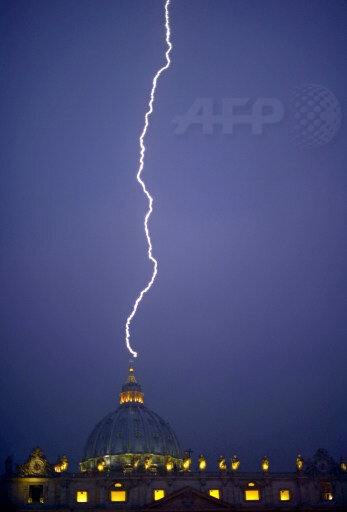
There has been a lot of talk this week about the Vatican and the selection of the new pope. The conclave starts Tuesday, March 12th, and even though I am not Catholic, I will be curious to see what color smoke rises from the makeshift chimney. When I saw NBC News' video of a man putting a chimney up on a Vatican roof, I was reminded of that amazing lightning strike on the day Pope Benedict XVI told the world that he was resigning.
The photo was taken by professional French photographer, Filippo Monteforte. According to a report in USA Today, it was a stormy day and Monteforte thought that maybe lightning would strike, and if it did what a wonderful picture it would make. He waited for over two hours and witnessed two bolts of lightning strike St. Peter's Basilica.
According to his blog post, Ferrell believes the photo is real. Some people expressed doubts because you can't see a reflection of light in the dome or on the wet street below. He explains that when lightning strikes it sends the current through the bolt dozens of times. The first number of times are too bright to capture on film. The last few times, however, aren't as strong or as bright. so that is when the bolt can be successfully photographed. At that stage the bolt has only "minimal reflection on nearby surfaces".
There was also the video that was taken and aired on BBC, thus giving the photograph more credibility. The video can be found on Youtube, was played in numerous news reports, and Ferrell also included it in his blog post.
Lightning is not a rare occurrence. In fact, National Geographic reports that lightning strikes the Earth more than a hundred times every second! Also, the common saying that "lightning doesn't strike twice" isn't true. Lightning doesn't keep track of where it has or hasn't been, all that it cares about is reaching the ground. Tall buildings, structures, and trees are very enticing. You never want to be the tallest object during a storm! You also don't want to take cover under the tallest object. Yes, that lone tree in the middle of the field may help keep you dry, but it is also the quickest route to the ground for lightning. Monteforte, the photographer, took a risk standing outside in the storm to get his now historic photograph.
St. Peters Basilica isn't the only building to be struck by lightning. 7 Most Incredible Skyscrapers Being Struck by Lightning offers more amazing pictures. I could not find other occurrences of the Basilica being struck by lightning, but that doesn't necessarily mean it hasn't happened before. Lightning striking on a random Wednesday wouldn't be much cause for alarm or speculation. Lightning striking the day the pope resigns... well, that will get people talking.
1. the composite or generally prevailing weather conditions of a region, as temperature, air pressure,humidity, precipitation, sunshine, cloudiness, and winds, throughout the year, averaged over a series of years.
2. a region or area characterized by a given climate: to move to a warm climate.
3. the prevailing attitudes, standards, or environmental conditions of a group, period, or place: a climate of political unrest.
The first definition is the one that applies to the topic of climate change. Here is how Dr. Heidi Cullen explains climate in her book The Weather of the Future, "weather is concerned with the immediate whereas climate is more focused on the long term."
Basically, weather is the day to day conditions we experience outside, like the things listed above in the definition. Then climate is those conditions in a larger area averaged out over time. The short video below from Climate Central, explains more.
The climate is changing. This decade and the last have been the warmest since the start of recording in the mid 1800's.
Some of the change is natural. This is because of how the different parts of the Earth interact, the land, the oceans, and the atmosphere. The sun and solar radiation also play a part in the changes.
Some of the change is caused by people. This is where greenhouse gases come into play. "Carbon dioxide (CO2) and water vapor (H2O), trap heat in the atmosphere causing a greenhouse effect."
These gases are released by burning coal, oil, and natural gas.
Here are some other interesting facts and tidbits I gathered from the US EPA website:
NASA and NOAA both agree that climate change is occurring and that humans are playing a role in the change.
The average temperature has risen 1.4F degrees, which has led to increased rainfall, heat waves becoming more frequent and more intense, warmer and more acidic oceans, and an increase in sea level due to arctic ice melting.
While the sun does have periods of warming and cooling, it does not appear to have as much of an impact on Earth as human activity.
A warmer climate does not mean no more cold winters. Actually, the slightly warmer climate means that there is more water up in the atmosphere, which can mean more snow when the temperature does drop low enough. But, as the climate grows warmer and warmer the length of our winters will grow shorter and shorter, but be snowier and snowier!
There is a natural carbon cycle, where carbon dioxide is naturally emitted but then also taken back up by plants and put into the ground. Humans burning fossil fuels is not part of this cycle and has thrown it out of whack!
Yes, the Earth was once warmer than it is today. But it was still stable back then, and it isn't stable now. It is projected to warm up faster than has ever been recorded.
The hole in the ozone, and thinning ozone layer is a negative consequence of human actions. While it is dangerous, and poses risks to our health, it is not significant to climate change.
IT IS NOT TOO LATE TO DO SOMETHING ABOUT CLIMATE CHANGE.
In my next post I plan to address different steps that are being taken to stop climate change. We will look at different government programs, and what you can do to make a difference.
Today,
February 5th, marks the birthdate of one of America’s very first weathermen, John
Jeffries born 1974. Jim Allsopp, Warning Coordination Meteorologist, NWS
Chicago wrote a
wonderful article about Jeffries and this special day.
Photo taken from wired.com GeekMom's blog
post, check it out!
I would
like to take this opportunity to thank all the weather people out there.
Weather forecasters can often take a verbal beating from the public. We can
become quite frustrated and even angry when the weather doesn’t turn out as
predicted. I often hear people saying that forecasters are always wrong. My
response to that is, “you try predicting the weather”. It is easy to dismiss
something we don’t fully understand. There are so many factors that play a role
in weather, like the jet stream, temperatures of the oceans, high and low
pressure areas, etc. and all these factors are ever changing. Scientists have
determined different patterns these factors follow and such, but there is
always a chance that the weather may do something unexpected, or behave in the
manner that was determined as less likely.
But,
enough of my rambling; let’s just remember that predicting the weather is not
easy and is not going to be an exact science. So, try not to get angry and if
there is a slight chance of rain… bring an umbrella!
Let us
also remember to thank the meteorologists, climatologists, other scientists,
and the people helping them with their research. There have been many strides
forward in understanding weather, storms, climate, and so forth, not just here
on Earth but also the weather in space like solar storms.
Lastly,
thank you to the weather enthusiasts. It is a fascinating topic and there will
always be those of us who love it and are fascinated by it.
Thank you
to everyone who loves the world we live in and the weather that shapes.
And just
remember,
Whether the weather be fine
Or whether the weather be not.
Whether the weather be cold
Or whether the weather be hot.
We'll weather the weather
Whether we like it or not.
All of us living on the east coast have experienced many a winter storm. Some of the worst, or rather many of the worst, we have called a Nor'easter. But, what exactly is a Nor'easter and why are they so severe?
According to The Weather Channel’s weather.com
a Nor'easter is a storm that starts with a large area of low pressure in the
Gulf Stream or of the East Coast.
But what is an area of low pressure?
About.com’s
Education: Geography page tells us that air pressure refers to how much
force is being applied to the surface of the Earth by the weight of the
air.
Wait, what?! The air doesn't
have weight!
Actually, it does!
See, the air is made up of molecules, such as nitrogen, oxygen, carbon dioxide, and
methane. These are not always present uniformly, meaning the amount of the
different gases can change. They also differ in size from one another and move
differently. These factors combine to
give the air weight by changing the temperature and density of the air mass in different areas. The air over Utah may be colder and have more carbon dioxide today, while the air over Tennessee may be warmer and have more nitrogen than carbon dioxide. Therefore, the pressure of the air over Utah will be different than the pressure of the air over Tennessee.
When there are a lot of air particles up there movin' around the pressure increases, and when there aren't a lot of air particles the
pressure then decreases. Check out the 10 minute video below for further explanation:
OK, so that’s easy
enough, low pressure means an area of less air particles. But, how does this
make a storm?
Something has to make the area of low pressure and these
things are typically warm air and high winds, which sounds to me like the
beginning of a storm. Now, there is a lot more to atmospheric pressure, more
details and more attributing factors, but this will get us started in
understanding a Nor'easter.
So, we are back to our area of low pressure in the Gulf
or off the east coast of the Atlantic.
Warm air, high winds, and well, access to a lot of water. This area of low pressure now starts to
travel north, east, or northeast, which could bring it up into any of the
states along the east coast, up into Canada, or just out to sea. The Weather Channel (TWC) tells us that if the
storm heads west of coastal cities like Boston or NYC then those areas will end
up with rain, but if the storm stays just off the coast and has plenty of water
in the clouds and enough cold air to make snow… BAM! Happy snow day children!
So I guess the storm is called a Nor'easter because it
happens on the east coast and heads north?
Well, not exactly. The storm gets its name because of the
northeasterly winds that blow in AHEAD of the storm. The winds can be very strong, and the storm
itself can pack a punch with continued high winds, large amount of snow, sleet,
or even freezing rain.
Even though we frequently associate the Nor'easter with
winter, it can occur any time of year! These storms have a peak season from
September to April and storms occurring then are often stronger than storms at other
times. HowStuffWorks
explains that when the low pressure system with its warm air collides with cold
air from the Arctic Mass it “fuels” the storm.
The HowStuffWorks article, written by Laurie L. Dove, brought
up another interesting tidbit that I had also planned to mention. You might have noticed that winter storms now have names! This started with the
nor'easter that slammed into an already suffering east coast after Hurricane
Sandy. TWC called the storm Athena, and has continued to name
winter storms all season. According to The Weather
Channel, they are naming storms in order to bring attention to them and the
danger they cause. Naming the storms
will make them stick out in people’s minds, and make it more difficult to just
ignore them. TWC believes that these
storms are dangerous and that people need to understand the dangers and how to
protect themselves.
These are the
reasons for naming the storms listed on TWC’s article linked above:
Naming a storm raises awareness.
Attaching a name makes it much easier
to follow a weather system’s progress.
A storm with a name takes on a
personality all its own, which adds to awareness.
In today’s social media world, a name
makes it much easier to reference in communication.
A named storm is easier to remember and
refer to in the future.
TWC took it upon themselves to create a list of names for
the storm:
From what I could find
online we have had storms up to Magnus, though I could have sworn there was a
winter storm Nemo too. It can be
difficult to find information on these storms by name because not everyone is
using them. TWC is privately owned and did not receive backing from the National
Weather Service to name the storms. It will be interesting
to see if other organizations end up joining in on the naming of the storms, or if
TWC channel will have to continue on naming storms by themselves, or if this will end
up being the only season with named storms.
Here are the links I used in writing this article and some additional links on the topic:
Alright, it’s about time to wrap this up. Hopefully, you now know a little more about Nor'easters. I know I have learned quite a bit myself. Please check out the pages where I gathered
my information from. They are linked
above but I will also include the links again below, along with some other cool
sites that are Nor'easter related.
Please feel free to share any information you have about
these storms, or any questions. I also
welcome your stories about the Nor'easters you've experienced!