Translate

Showing posts with label storm. Show all posts

05 May 2013

Flooding in the Last Five Years: 2010

About a week ago I put up the first post in a series of five about flooding. That one was titled Flooding in the Last Five Years: 2009 and recapped the major flooding events that year. I also gave the total cost of damages and lives lost do to flooding. There were about 8 major events, with 51 deaths and just over a billion in damages that year.

Now, let's take a look at what the year 2010 brought us, in terms of flooding. I am pulling information from a yearly report provided by The National Weather Service/NOAA. There you can find more information about the year and each of the events.

2010

  • March: Flooding in much of the Northeast due to an early thaw. First, in parts of New Jersey, Connecticut, Rhode Island and Massachusetts the snow melted right before a large rain storm. This over saturation caused flooding. Then a couple weeks later the snow in New Hampshire and Vermont melted, this added more water to already swollen rivers in Massachusetts. This month saw some serious flooding, especially in New Jersey's Passaic River Basin.

    The damages for the month totaled $330 million over the four states. Amazingly, there were no flood-related deaths.


  • May: Heavy rainfall causes flooding in Tennessee and Kentucky. Rainfall records were broken, and many rivers also rose to record heights. This flooding cost $2.3 BILLION and 26 lives were lost.
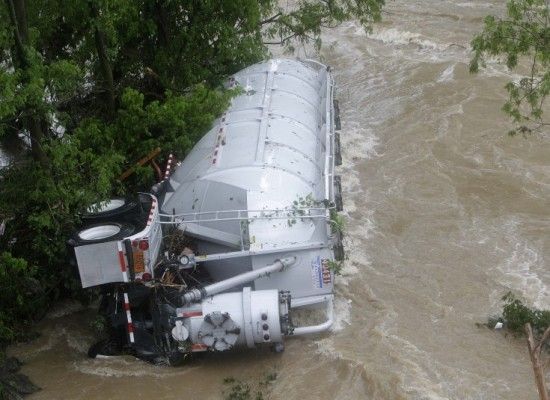
A tanker truck is pushed against trees after being washed away, 
Sunday, May 2, 2010 in Nashville, Tenn.
 (AP Photo/Mark Humphrey)


  • June: Flash flooding due to storms in Texas and Arkansas. This flooding caused towns to be evacuated in Texas. In Arkansas, campers by the Little Missouri River were wakened by flash flooding. This was another deadly event with 20 deaths and 26 people injured. This storm cost $9 million in damages.

    A second flooding event occurred in June, when a storm dumped heavy rains on Oklahoma City. The timing of the storm during and right before rush hour caused many vehicles to become stuck in the waters. There were 130 injuries, one death and and about $6 million in damages.


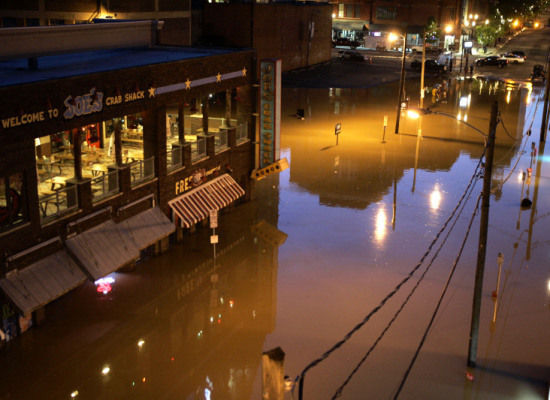
Search for Flood Survivors
Photograph by Sue Ogrocki, AP


  • July: The first of four flood events this month was in Alaska. Flooding from a storm caused washouts and mudslides. In Alaska, flash floods are rare, but they did occur with this storm. One person lost his or her life. The report did not list the amount of damages associated with this particular event.

    The second episode of flooding occurred in Iowa. Technically, the event started in June with many heavy rain storms. So, in late July, the ground couldn't hold any more water and the next round of storms caused flooding. This severely damaged the corn and soybean crop. There were no deaths or serious injuries reported, but there was about $50 million in property damages and an estimated $1 billion in agricultural damage.


Then, in Wisconsin, again the rains in June set up the scenario where the rains in July couldn't be absorbed, leading to flooding there as well. There was one death reported and about $27.7 million in damages.

The fourth notable flood event in July occurred in Texas along the Rio Grande. It started with the remnants of Hurricane Alex, and then Tropical Depression #2 pushed the river over the edge. The flooding lasted for about the entire month of July! The President declared many counties in the Rio Grande Valley as areas of Major Disaster. There were three deaths and over $110 million in damages.

KXAN - Jim Spencer/blog
  • September: Flooding in Texas and Oklahoma occurred due to Tropical Storm Hermine. There was $29 million in damages and six deaths.


  • September/October: Remnants of Tropical Storm Nicole met up with a low front, which led to intense rainfall and flooding along the Eastern Seaboard. It affected North Carolina's mainland and Outer Banks, the Catskills of New York, and parts of Pennsylvania. This storm also caused damage to crops, so the totals were $20 million in property damages, $70 million in agricultural damages and seven fatalities.


Well, looks like another bad year for flooding! Unlike 2009, we saw some serious flooding due to tropical storms.

So let's review the totals! Using the same chart as in the last post, provided in the report by the NWS, there were a total of 112 flood-related deaths and $5,041,227 in damages.

The amount in damages in 2010 was over 5 times the amount in 2009! And, over double the amount of fatalities!

Yikes!

Next in this series of posts we will examine 2011 in this same format. I know 2011 saw Hurricane Irene...

Then there was Hurricane Sandy in 2012, but Water Year 2012  runs October 1st 2011-September 30th
2012, so Hurricane Sandy will actually be included in the 2013 Water Year evaluation.

Looking ahead makes me think that these numbers are going to get worse, before they get better.

So, stay tuned for the third post in this five-part series about Flooding the the Last Five Years.


29 April 2013

Flooding in the Last Five Years: 2009

With the recent flooding in the Midwest, I thought it would be interesting to look at flooding in the United States over the last five years. I did some research into different areas that flooded, how badly, and how much did it cost. At first I was going to put all five years into one post, but it was turning out to be longer than I thought! I have decided to run this topic over a few postings. Here is the first.

2009


Flooded homes, fields, and roads are shown from the air Thursday, Jan. 8, 2009 near Chehalis, Wash.


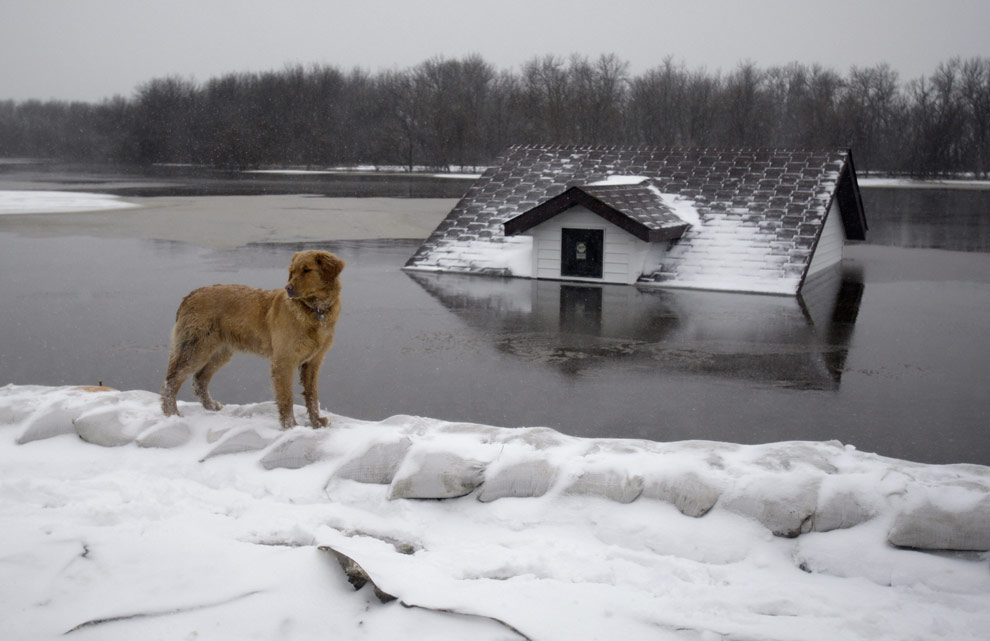
Elsie, one of two Stensgard family dogs, sands on the earthen and sandbag dike surrounding the Stensgard home, not pictured, which overlooks a flooded outbuilding as the Red River continues to rise, Wednesday, March 25, 2009 in Fargo, N.D. Due to the flooding, the Stensgard home can only be reached by boat. (AP Photo/Carolyn Kaster)

  • April: Flooding in the Red River Valley in Oklahoma and Texas, due to a large storm system. Flash flooding also occurred in Kansas and Missouri because of thunderstorms. About $42.9 million in damages and five lives lost.

Flooding in Claremore May 1, 2009 (Courtesy of KJRH.com, Randy Lane)

  • May: Flood in Alaska due to ice jam. As the snow and ice from the winter melts pieces of ice break off and float down stream. They can jam together and block the waterway, leading to flooding in the area. A large jam caused "the worst flooding in recorded history" on the Yukon River in Eagle, Alaska. There were no deaths and about $29 million in damages.

Yukon River flood damage, May 2009. The river rose to 20 feet above flood level. Downtown Eagle waterfront looking East. Uploaded by AlaskaMark

  • June: Flash flooding in Wisconsin was caused by a band of thunderstorms. Each storm dumped a large amount of water in a short period of time. There was about 25.6 million in damages and no flood-related deaths.
A second flood event occurred in Michigan. Flash flooding due to storms caused 41.3 million more in damages. No deaths occurred due to this event either. 


  • August: There was flooding due to heavy rains in Kentucky and part of Indiana. Luckily, there were no lives lost, but there was about $45.3 million in damages. The rate of rainfall was amazing; "rainfall rates up to 8.8 inches per hour were reported"!

FLOODING NEAR KENTUCKY KINGDOM (PHOTO COURTESY TIPSTER)

  • September: A large storm system across parts of Georgia, Alabama, Tennessee, South and North Carolina stalled and rained for days. This was by far the worst flooding of the year, with 11 deaths and over $250 million in damages.


These were just the worst flood events of the year. The National Weather Service reported that the total deaths and damages were much higher than the totals of the numbers above. There is a chart in the NWS report that includes deaths and damages in all 50 states, plus Washington D.C., Guam, Puerto Rico/Virgin Islands, and America Samoa. The total number of lives lost due to flood in 2009 was 51 and the damages totaled just over a billion at $1,000,026.

This seems like a lot to me! Maybe this was a bad year for floods... or maybe this is the norm?

Next time I will look the major floods and total damages in 2010. Then for the next year and so on...

By the end of this series of posts, I think we will have a better idea of the flood trends that are happening currently. And, we may then better understand the risk of flooding in our country, and the damages it causes us.

Thanks for reading and stay tuned for the second installment, Flooding in the Last Five Years: 2010.

12 April 2013

Exploring Thunderstorms

Severe storms have been rolling across the continental U.S. this week. A tornado touched down in Mississippi, killing one person and injuring others. Below is a short video from an article on CNN of the tornado.


In my area we didn't have anything as severe as a tornado, but we did have our first thunderstorms of the season. As I lay in bed listening to the thunder, I decided it was a perfect time to write a post about thunderstorms.

I had touched a bit on lightning in my post When Lightning Strikes the Vatican and now I would like to expand on the topic.

I found some great information on NOAA's National Severe Storms Laboratory website.

First, let's explore how a thunderstorm is created.

It starts with the sun heating the Earth's surface, which in turn warms the air above that part of the ground. Something then has to "bump" the air and cause it to start to rise. According to the site, this could be other colder or wetter air, mountains or hills. If this rising air remains warmer and lighter than the air around it, it will continue rising.

As the warm air rises up into the atmosphere "the water vapor it contains begins to cool, releases the heat, condenses and forms a cloud".

Weatherquestions.com
The cloud grows bigger and bigger and will eventually reach air that is below freezing. Up there the water droplets freeze and start bouncing around. When they collide they pull bits of ice off of each other, along with electrical charge. This charge builds and builds then releases in a bolt of lightning either cloud to cloud or to the ground. The bolt creates a sound wave which is the thunder!

That wasn't too hard! But, how does this end? I mean, thunderstorms don't last forever, so when does it stop  and dissipate?

Thunderstorms have three stages to their lives, developing, mature, and dissipating. We have already covered the first two stages so lets take a look at the third.

During the mature part of the storm the warm air from the ground is still rising up into the cloud and pushing water vapor into the freezing air. As long as the air keeps rising the storm keeps going. Eventually, all the precipitation and wind coming down from the cloud overpowers the warm air rising up. The supply of new water stops and the precipitation raining down will slow and stop. Just be aware, even though the rain has stopped the lightning can continue for awhile.

Photo from NOAA NSSL:Severe Weather 101
Ok, so I feel like I now have a pretty good grasp on the thunderstorm itself. Let's explore lightning a little more.

Once again, NOAA's National Severe Storms Laboratory has an excellent site with all sorts of information about lightning.

You know those little jagged pictures of lightning that we drew as children?

Turns out that lightning really is jagged! "Lightning is a channel of electrical charge called a stepped leader that zigzags downward in roughly 50-yard segments in a forked pattern."

Or course, we can't actually see it, so our drawings weren't exactly accurate, but it's still pretty neat!

I thought this was cool too. "As it nears the ground, the charged step leader is attracted to a channel of opposite charge reaching up, a streamer, normally through something tall, such as a tree, house, or telephone pole."

It is when these two meet, the bolt and the streamer, that the current starts surging. I had mentioned in my previous post about lightning that the current goes through the lightning bolt multiple times. This is because when the two meet, a backlash of current actually travels back UP toward the cloud! One bolt can send up to twenty return strokes giving the bolt the appearance of flashing. Below is a short video from National Geographic on the topic.


This video doesn't mention ice particles causing the electrical charge, but it does explain the separation of the charges and the resulting release in the form of lightning.

So, what about thunder? Lightning causes thunder, so if you hear thunder you can be certain that somewhere there was lightning!

A lightning bolt heats the air around it, and heated air expands. It is so hot, and the air expands so quickly that it causes a sound wave, and that is what we hear.

Have you ever noticed that when the storm is close enough you can actually hear three distinct sounds in the thunder? First, there is a tearing sound as the lightning rips down through the sky. Then a sharp cracking sound caused by the streamer reaching up from the ground, followed by the rolling boom of thunder, which is what we hear when farther away.

This all happens very quickly so don't feel bad if you don't know what I am talking about. I have spent a lot of hours just sitting and listening to storms. It was actually a favorite activity in my family! Most people will be able to at least identify the crack and then the boom.

I think thunderstorms are amazing and are one of my favorite weather events. I love listening to them and watching them whenever possible. I will admit that I probably take too many risks when it comes to thunderstorms, but I just can't help it!

On that note, lightning safety is very important, and therefore, needs a post of its own. So, please check back soon for tips on thunderstorm safety!

10 March 2013

When Lightning Strikes the Vatican

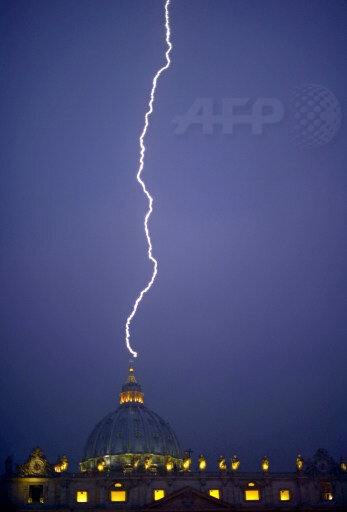
There has been a lot of talk this week about the Vatican and the selection of the new pope. The conclave starts Tuesday, March 12th, and even though I am not Catholic, I will be curious to see what color smoke rises from the makeshift chimney. When I saw NBC News' video of a man putting a chimney up on a Vatican roof, I was reminded of that amazing lightning strike on the day Pope Benedict XVI told the world that he was resigning.

The photo was taken by professional French photographer, Filippo Monteforte. According to a report in USA Today, it was a stormy day and Monteforte thought that maybe lightning would strike, and if it did what a wonderful picture it would make. He waited for over two hours and witnessed two bolts of lightning strike St. Peter's Basilica.

There was some speculation that, perhaps, the photo was a fake. Jesse Ferrell, a weather and social media blogger on Accuweather.com, addressed this doubt in his post, Did Lightning Really Strike Vatican After Pope's Resignation?  

According to his blog post, Ferrell believes the photo is real. Some people expressed doubts because you can't see a reflection of light in the dome or on the wet street below. He explains that when lightning strikes it sends the current through the bolt dozens of times. The first number of times are too bright to capture on film. The last few times, however, aren't as strong or as bright. so that is when the bolt can be successfully photographed. At that stage the bolt has only "minimal reflection on nearby surfaces".


There was also the video that was taken and aired on BBC, thus giving the photograph more credibility. The video can be found on Youtube, was played in numerous news reports, and Ferrell also included it in his blog post.


Lightning is not a rare occurrence. In fact, National Geographic reports that lightning strikes the Earth more than a hundred times every second! Also, the common saying that "lightning doesn't strike twice" isn't true. Lightning doesn't keep track of where it has or hasn't been, all that it cares about is reaching the ground. Tall buildings, structures, and trees are very enticing. You never want to be the tallest object during a storm! You also don't want to take cover under the tallest object. Yes, that lone tree in the middle of the field may help keep you dry, but it is also the quickest route to the ground for lightning. Monteforte, the photographer, took a risk standing outside in the storm to get his now historic photograph.

St. Peters Basilica isn't the only building to be struck by lightning. 7 Most Incredible Skyscrapers Being Struck by Lightning offers more amazing pictures. I could not find other occurrences of the Basilica being struck by lightning, but that doesn't necessarily mean it hasn't happened before. Lightning striking on a random Wednesday wouldn't be much cause for alarm or speculation. Lightning striking the day the pope resigns... well, that will get people talking.