Translate

Showing posts with label tropical storm. Show all posts

06 May 2013

How To Handle A Hurricane

If you were adventurous and read my post, Let's Talk Hurricanesthen you already know quite a bit about them. What I didn't discuss was how to prepare for one and what to do during a storm. So, let's talk about that now, shall we?

The first thing to understand is the difference between a hurricane watch and a hurricane warning. The American Red Cross explains that a hurricane watch means that within 48 hours meteorologists expect hurricane conditions to reach that area. Once that time period becomes 36 hours, until hurricane conditions arrive, the watch becomes a warning.

The National Weather Service tells us that a watch means we should 'be on guard'! Keep an eye on the weather reports, go over your emergency plans with your family, and get ready! Then the warning means "this is it, get ready 'cause here it comes"!

There is plenty to do to prepare before any hurricane watches or warnings. Like I have mentioned in my other posts about preparing for bad weather, How To Prepare For Tornado Season and Flooding - It Could Happen To You, it is essential that your household have a family communications plan and an emergency kit. Ready.gov, a preparation and information site managed by FEMA, can walk you through creating your own kit and developing your communications plan.

There are three main areas we are going to focus on in this post: preparing for the storm, what to do during the storm, and recovering from the storm. I gathered information from three sources to present to you: American Red Cross, National Hurricane Center/NOAA, and Ready.gov/FEMA.

Before a storm

  • Develop a family communications plan.
  • Build your emergency kit.
  • Find out if your home is in an area that is vulnerable to wind, flood, and/or storm surge.
  • Find out if there are any levees or dams that could affect your residence.
  • Be prepared to have to cover your windows. This may mean installing storm shutters or just having plywood on hand to cover the windows. Tape will not prevent your windows from breaking! 
  • Consider installing straps to your roof! Let EHow.com walk you through it!
  • Trimming trees and bushes around the house will make them more wind resistant, and take off dead or dying limbs that may come down during high winds.
  • Make sure rain gutters and downspouts are clear!
  • Consider reinforcing your garage door. Wind inside a garage can do some expensive structural damage!
  • Make sure you have a place to bring in any outdoor items, such as patio furniture and garbage cans. Anything that can't be secured outside must come inside!
  • Consider purchasing a generator.

Storm is coming!

  • Listen for updates and information from the National Weather Service & FOLLOW ALL INSTRUCTIONS GIVEN!
  • Secure items outside and bring in anything that cannot be tied down.
  • Close hurricane shutters and doors, or place plywood over the windows and doors.
  • In case the power goes out, turn your refrigerator and freezer all the way up and try to open them as little as possible. This way, if the power does go out, your food will stay cooler for longer.
  • Make sure your car's gas tank is full.
  • Unplug all the small appliances and shut off the propane tank, if you have one.
  • Fill the bath tub and other containers with water, so that you have water to flush the toilet, or to wash with.
  • Review your communications plan, and ready your emergency kit!
  • Consider evacuation if:
    • the authorities tell you to leave the area.
    • you live in a mobile home, or other unstable structure.
    • you live above the 10th floor of a building.
    • you live in an area prone to flooding, such as the coast or a flood plain.

Storm is here!

  • If you didn't evacuate:
    • Stay inside and away from windows and doors!
    • Close the doors INSIDE your home!
    • Like with a tornado, stay in an interior room on the lowest floor of the home and take cover under a sturdy object like a table.
  • Try not to use your phone, unless it's an emergency, of course.
  • Be on the alert for tornadoes. As we learned in my post, Let's Talk Hurricanes..., the spiral rain bands can spawn tornadoes.
  • Don't be fooled by the eye of the storm! It may seem like it's over, but it's not. Once the eye passes the hurricane winds will come back at full force!

After the storm

  • Keep listening, or watching, for weather reports and updates.
  • Be on the alert for possible flooding even after the storm has passed.
  • If you evacuated, don't return until an official has told you it is safe to do so.
  • Try to stay off the roads, but if you must drive go slow and avoid flooded or washed out roads and bridges.
  • Keep a look out for downed power lines. If spotted, stay away from them and report them to the power company.
  • Take pictures of any damages to your home or belongings, for insurance purposes.
  • If the power is out use flashlights, DO NOT USE CANDLES. (This is a new one for me! We always lit candles when I was a kid, but then again we had bad snowstorms, not hurricanes.)
  • Don't drink the water until you know that it is safe.
  • Throw out any spoiled food, and remember, better safe than sorry. Trust me, not much is worse than food poisoning!
  • Again, stay off the phone.
  • Make sure you be careful, and protect your pets!

Feel free to check out all three websites that I used, for more information. Hurricane season is coming, so we might as well start getting ready!

Thanks for reading and be safe!

05 May 2013

Flooding in the Last Five Years: 2010

About a week ago I put up the first post in a series of five about flooding. That one was titled Flooding in the Last Five Years: 2009 and recapped the major flooding events that year. I also gave the total cost of damages and lives lost do to flooding. There were about 8 major events, with 51 deaths and just over a billion in damages that year.

Now, let's take a look at what the year 2010 brought us, in terms of flooding. I am pulling information from a yearly report provided by The National Weather Service/NOAA. There you can find more information about the year and each of the events.

2010

  • March: Flooding in much of the Northeast due to an early thaw. First, in parts of New Jersey, Connecticut, Rhode Island and Massachusetts the snow melted right before a large rain storm. This over saturation caused flooding. Then a couple weeks later the snow in New Hampshire and Vermont melted, this added more water to already swollen rivers in Massachusetts. This month saw some serious flooding, especially in New Jersey's Passaic River Basin.

    The damages for the month totaled $330 million over the four states. Amazingly, there were no flood-related deaths.


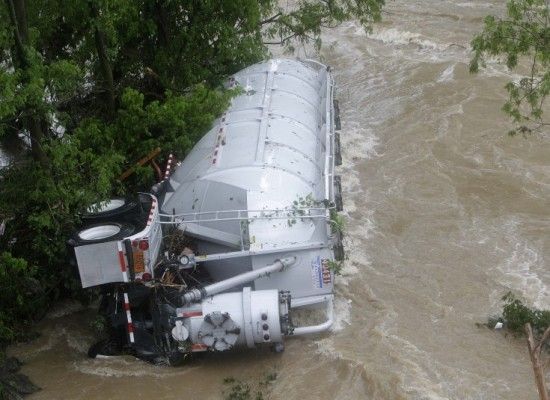
  • May: Heavy rainfall causes flooding in Tennessee and Kentucky. Rainfall records were broken, and many rivers also rose to record heights. This flooding cost $2.3 BILLION and 26 lives were lost.

A tanker truck is pushed against trees after being washed away, 
Sunday, May 2, 2010 in Nashville, Tenn.
 (AP Photo/Mark Humphrey)


  • June: Flash flooding due to storms in Texas and Arkansas. This flooding caused towns to be evacuated in Texas. In Arkansas, campers by the Little Missouri River were wakened by flash flooding. This was another deadly event with 20 deaths and 26 people injured. This storm cost $9 million in damages.

    A second flooding event occurred in June, when a storm dumped heavy rains on Oklahoma City. The timing of the storm during and right before rush hour caused many vehicles to become stuck in the waters. There were 130 injuries, one death and and about $6 million in damages.


Search for Flood Survivors
Photograph by Sue Ogrocki, AP


  • July: The first of four flood events this month was in Alaska. Flooding from a storm caused washouts and mudslides. In Alaska, flash floods are rare, but they did occur with this storm. One person lost his or her life. The report did not list the amount of damages associated with this particular event.

    The second episode of flooding occurred in Iowa. Technically, the event started in June with many heavy rain storms. So, in late July, the ground couldn't hold any more water and the next round of storms caused flooding. This severely damaged the corn and soybean crop. There were no deaths or serious injuries reported, but there was about $50 million in property damages and an estimated $1 billion in agricultural damage.


Then, in Wisconsin, again the rains in June set up the scenario where the rains in July couldn't be absorbed, leading to flooding there as well. There was one death reported and about $27.7 million in damages.

The fourth notable flood event in July occurred in Texas along the Rio Grande. It started with the remnants of Hurricane Alex, and then Tropical Depression #2 pushed the river over the edge. The flooding lasted for about the entire month of July! The President declared many counties in the Rio Grande Valley as areas of Major Disaster. There were three deaths and over $110 million in damages.

KXAN - Jim Spencer/blog
  • September: Flooding in Texas and Oklahoma occurred due to Tropical Storm Hermine. There was $29 million in damages and six deaths.


  • September/October: Remnants of Tropical Storm Nicole met up with a low front, which led to intense rainfall and flooding along the Eastern Seaboard. It affected North Carolina's mainland and Outer Banks, the Catskills of New York, and parts of Pennsylvania. This storm also caused damage to crops, so the totals were $20 million in property damages, $70 million in agricultural damages and seven fatalities.


Well, looks like another bad year for flooding! Unlike 2009, we saw some serious flooding due to tropical storms.

So let's review the totals! Using the same chart as in the last post, provided in the report by the NWS, there were a total of 112 flood-related deaths and $5,041,227 in damages.

The amount in damages in 2010 was over 5 times the amount in 2009! And, over double the amount of fatalities!

Yikes!

Next in this series of posts we will examine 2011 in this same format. I know 2011 saw Hurricane Irene...

Then there was Hurricane Sandy in 2012, but Water Year 2012  runs October 1st 2011-September 30th
2012, so Hurricane Sandy will actually be included in the 2013 Water Year evaluation.

Looking ahead makes me think that these numbers are going to get worse, before they get better.

So, stay tuned for the third post in this five-part series about Flooding the the Last Five Years.