Translate

Showing posts with label preparedness. Show all posts

06 May 2013

How To Handle A Hurricane

If you were adventurous and read my post, Let's Talk Hurricanesthen you already know quite a bit about them. What I didn't discuss was how to prepare for one and what to do during a storm. So, let's talk about that now, shall we?

The first thing to understand is the difference between a hurricane watch and a hurricane warning. The American Red Cross explains that a hurricane watch means that within 48 hours meteorologists expect hurricane conditions to reach that area. Once that time period becomes 36 hours, until hurricane conditions arrive, the watch becomes a warning.

The National Weather Service tells us that a watch means we should 'be on guard'! Keep an eye on the weather reports, go over your emergency plans with your family, and get ready! Then the warning means "this is it, get ready 'cause here it comes"!

There is plenty to do to prepare before any hurricane watches or warnings. Like I have mentioned in my other posts about preparing for bad weather, How To Prepare For Tornado Season and Flooding - It Could Happen To You, it is essential that your household have a family communications plan and an emergency kit. Ready.gov, a preparation and information site managed by FEMA, can walk you through creating your own kit and developing your communications plan.

There are three main areas we are going to focus on in this post: preparing for the storm, what to do during the storm, and recovering from the storm. I gathered information from three sources to present to you: American Red Cross, National Hurricane Center/NOAA, and Ready.gov/FEMA.

Before a storm

  • Develop a family communications plan.
  • Build your emergency kit.
  • Find out if your home is in an area that is vulnerable to wind, flood, and/or storm surge.
  • Find out if there are any levees or dams that could affect your residence.
  • Be prepared to have to cover your windows. This may mean installing storm shutters or just having plywood on hand to cover the windows. Tape will not prevent your windows from breaking! 
  • Consider installing straps to your roof! Let EHow.com walk you through it!
  • Trimming trees and bushes around the house will make them more wind resistant, and take off dead or dying limbs that may come down during high winds.
  • Make sure rain gutters and downspouts are clear!
  • Consider reinforcing your garage door. Wind inside a garage can do some expensive structural damage!
  • Make sure you have a place to bring in any outdoor items, such as patio furniture and garbage cans. Anything that can't be secured outside must come inside!
  • Consider purchasing a generator.

Storm is coming!

  • Listen for updates and information from the National Weather Service & FOLLOW ALL INSTRUCTIONS GIVEN!
  • Secure items outside and bring in anything that cannot be tied down.
  • Close hurricane shutters and doors, or place plywood over the windows and doors.
  • In case the power goes out, turn your refrigerator and freezer all the way up and try to open them as little as possible. This way, if the power does go out, your food will stay cooler for longer.
  • Make sure your car's gas tank is full.
  • Unplug all the small appliances and shut off the propane tank, if you have one.
  • Fill the bath tub and other containers with water, so that you have water to flush the toilet, or to wash with.
  • Review your communications plan, and ready your emergency kit!
  • Consider evacuation if:
    • the authorities tell you to leave the area.
    • you live in a mobile home, or other unstable structure.
    • you live above the 10th floor of a building.
    • you live in an area prone to flooding, such as the coast or a flood plain.

Storm is here!

  • If you didn't evacuate:
    • Stay inside and away from windows and doors!
    • Close the doors INSIDE your home!
    • Like with a tornado, stay in an interior room on the lowest floor of the home and take cover under a sturdy object like a table.
  • Try not to use your phone, unless it's an emergency, of course.
  • Be on the alert for tornadoes. As we learned in my post, Let's Talk Hurricanes..., the spiral rain bands can spawn tornadoes.
  • Don't be fooled by the eye of the storm! It may seem like it's over, but it's not. Once the eye passes the hurricane winds will come back at full force!

After the storm

  • Keep listening, or watching, for weather reports and updates.
  • Be on the alert for possible flooding even after the storm has passed.
  • If you evacuated, don't return until an official has told you it is safe to do so.
  • Try to stay off the roads, but if you must drive go slow and avoid flooded or washed out roads and bridges.
  • Keep a look out for downed power lines. If spotted, stay away from them and report them to the power company.
  • Take pictures of any damages to your home or belongings, for insurance purposes.
  • If the power is out use flashlights, DO NOT USE CANDLES. (This is a new one for me! We always lit candles when I was a kid, but then again we had bad snowstorms, not hurricanes.)
  • Don't drink the water until you know that it is safe.
  • Throw out any spoiled food, and remember, better safe than sorry. Trust me, not much is worse than food poisoning!
  • Again, stay off the phone.
  • Make sure you be careful, and protect your pets!

Feel free to check out all three websites that I used, for more information. Hurricane season is coming, so we might as well start getting ready!

Thanks for reading and be safe!

23 April 2013

Interview With a Warning & Coordination Meteorologist

We have been talking for a few months now about weather events and climate issues. I feel like I have learned quite a bit, and hopefully you have too.

I thought it would be interesting to reach out and interview someone who actually works in the field of meteorology.

With help from my mentor Dr. Lance Strate and his colleague Dr. Susan Jasko I was put in touch with Warning & Coordination Meteorologist, Mr. Mark Fox.

Nyssa: First, please tell us a little about yourself. Where are you from, what is your background, and so forth?

Mark: I grew up in Oklahoma, and developed a fascination with tornadoes pretty early. I saw my first tornado when I was 9, as a F3 tornado moved through my hometown of Stillwater, Oklahoma. We lived on a hill west of town and saw the entire thing. Since then, I've been hooked.

I got a degree in meteorology from the University of Oklahoma in 1989. That same year, I began as a broadcast meteorologist. Worked in TV for about ten years, and started with the National Weather Service in 1999. 


Nyssa: So, where do you currently work and what is your position there?

Mark: I am currently the Warning & Coordination Meteorologist for the Weather Forecast Office (WFO) in Fort Worth, TX.

Nyssa: What is a typical day like for a Warning & Coordination Meteorologist? 

Mark: Ha! What is typical? Most days, I am getting ready for events in the future. I’m getting ready by meeting with our partners (Emergency Management, Media, elected officials) or spotter groups. During severe weather, I spend most of my time communicating the forecast that our office produces. That means gathering my opinions about what will happen, making sure I am on the same page as our forecasters and then communicating early and often with our partners. I’m not necessarily the one that sends the warnings, but on occasion, I am.

Nyssa:  How did you end up becoming the Warning & Coordination Meteorologist? 

Mark: Good question. I started at this office (Fort Worth) as a non-traditional meteorologist intern in 1999. I worked here for about two years before getting a general forecaster position in Amarillo, TX. While there, I worked with two of the best meteorologists (and people) you would ever hope to work for, Jose Garcia and Steve Drillette. They both mentored me, helped me to understand that meteorology is only the beginning; lives are saved based on actions taken after the warning is issued. Since that time, I've been working on how to better communicate risk information. That work led to a promotion to a senior forecaster at WFO Lubbock, then to the Regional Training Officer for the Southern Region of the National Weather Service. I started this position in August of 2009.

Nyssa: It's great that you had such positive influences; mentors can play a big role in our lives. Tell us, what is the most difficult part of your job?

Mark: Let’s just say there are meteorologists in all fields that believe that forecasters should write the forecast and nothing more. Trying to convince people with this mindset to change can be difficult.

Nyssa: That does sound frustrating! So, what part do you find the most enjoyable?

Mark: Without a doubt, helping people make good decisions based on our forecasts.

Nyssa: I was wondering, what do you think has been a big leap forward in the field of risk communication?


Mark: The big leap, in my opinion, is social media. You used to get weather information from us, or more likely from TV. You can still get that, but now you can also get the weather information from friends, family, and friends of friends. This can have a negative impact, but the more personal the threat becomes, the more likely people are going to act. (which is good)

Nyssa: Can you expand a little on the role of social media in your field?

Mark: Four years ago, social media had no role. Today, social media is a large part in what we do. Four years from now, who knows what will be next. We have to be ready.

Nyssa: What do you see for the future of storm warnings?

Mark: Storm warnings have to get more personal, and I think social media will play an increasing role. Years ago, we heard nothing until the warning was out. And then we heard nothing until the official update. Now, we hear about the storm forecast. We hear about the clouds developing. We hear about the rain and hail beginning. We hear about the hail getting bigger. We hear the warning. We then hear where the storm is. (etc.) In other words, the information around the official storm warning can be more important than the actual warning itself.

Nyssa: I too have noticed that the coverage of weather events has gotten more extensive. By me, Hurricane Irene and Sandy were on almost every channel for days. Do you think this extreme coverage is a positive for people? Or, do you feel that it is becoming too sensationalized?

Mark: How did you respond the first time you ever heard a car alarm going off? Do you even notice if a car alarm goes off now? The more we ramp up forecasts and warnings and nothing happens, that has a negative impact on people. We need to get it right, but we also need to communicate the threat more effectively.

Nyssa: That being said, what do you think is the most important thing that the public should understand about storm warnings?

Mark: Bad storms happen to good people. Storms do not discriminate, so you have to be ready. A lot of folks think bad storms happen to “other people” and not themselves. Complacency is a huge issue. Think about how many storm warnings you were in… and nothing happened? That can be a false sense of security.

Nyssa: I am going to change the topic for a minute. Climate change is an issue that I have discussed in a few of my posts. What is your stance on climate change?

Mark: The data suggests the climate has been changing. The question then becomes what is causing it? Is it natural? Has it happened before? All too often, it becomes a political argument, and that’s an argument as a scientist I’d like to stay away from.

Nyssa: I completely understand, it has become a hard issue for non-scientists to follow, I feel because of the politics. It's hard to know what is going on with all the conflicting information. So, getting back to your area of expertise, what wisdom or tip would you give to a student interested in working in the field of meteorology?

Mark: You will be wrong. Take your work seriously. Don’t take yourself too seriously.

Nyssa: Great advice for anyone! And one last thought to leave us with?

Mark: Bad storms are a matter of when…not if.

Nyssa: Thank you so much for taking the time to talk with me. I really appreciate it as this interview has been very interesting. I definitely think my readers and I have learned a few things, and I know I enjoyed the interview. Good luck in all your future endeavors, and let's hope for calm weather this summer!


21 April 2013

Flooding - It Could Happen To You

Let's talk flood protection. Once again I headed on over to FEMA. In case you didn't know, FEMA stands for Federal Emergency Management Agency. I find this agency's website to be very helpful, the information is relevant and  (in my opinion) trustworthy.


Ready.gov is the FEMA site that provides information on how to prepare for multiple disasters and events, like floods.

You may think that you don't need to read this post or prepare for a flood because you have never flooded before.

Wrong.

Flooding can happen to anyone, anywhere. Even if you don't want to take all the steps I am going to go through in this post, it is good to at least be aware of the possibility.

The first thing is to make sure you have an emergency kit and plan. I discussed this in my post How To Prepare For Tornado Season. Ready.gov walks you through how to develop and maintain your kit here. Then you can go here to work on your emergency plan!

This is a good reminder for those of you who meant to do this after reading my other post. Don't feel bad, I still haven't done it either! I will though, because I really do think it is important.

It is also important to understand the risk of flooding in your area. This can be done by reviewing a Flood Insurance Rate Map of your area.

Well, checking the map didn't work very well for me! I checked the area where I live now and was told "sorry there are no items to display for this State, County and Community. Please check the Future or Historic Maps for available panels."

Ah, then I saw further down on the FEMA site that they are changing the maps. Going digital, Digital Flood Insurance Rate Map (DFIRM).

These maps are important not just because they tell you your risk, but because they also tell you how much flood insurance will cost you. These new maps may change the cost of your flood insurance. If you already have insurance you may want to check with your agent to see if you are on the new one, or the old. When considering flood insurance for the first time, ask if there is a DFIRM for your area.

My town map isn't available in the new map catalog either. "Enter your Zip Code to see all of the communities in your county that have maps scheduled to be updated. Even if your community is not listed, changes may still be in progress." Perhaps that is the case for my town...

Well checking these maps turned out to be difficult for me! Hopefully, some of you will have better luck. If not, my suggestion would be calling a flood insurance agent and discussing the risk to your area. You don't have to buy, just become informed.

These are the other preparations that FEMA suggests:
  • Avoid building in a floodplain unless you elevate and reinforce your home.
  • Elevate the furnace, water heater and electric panel in your home if you live in an area that has a high flood risk.
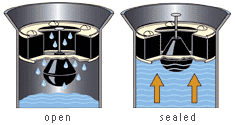
  • Consider installing "check valves" to prevent flood water from backing up into the drains of your home.
  • If feasible, construct barriers to stop floodwater from entering the building and seal walls in basements with waterproofing compounds.
According to Friends of the River a floodplain is the low flat area along a river that can flood periodically. Unfortunately, this area while not flooded is a pretty enticing area to build or farm on. However, this is an area that can and will flood. When the river becomes too high, it will expand into the floodplain.

If you do decide to build on a floodplain, make sure you plan ahead and build appropriately.

WiseGeek explains that a check valve makes it so that water can only travel in one direction. It is also called a one way valve or a nonreturn valve, and works in a couple different ways. The most common being a ball valve.

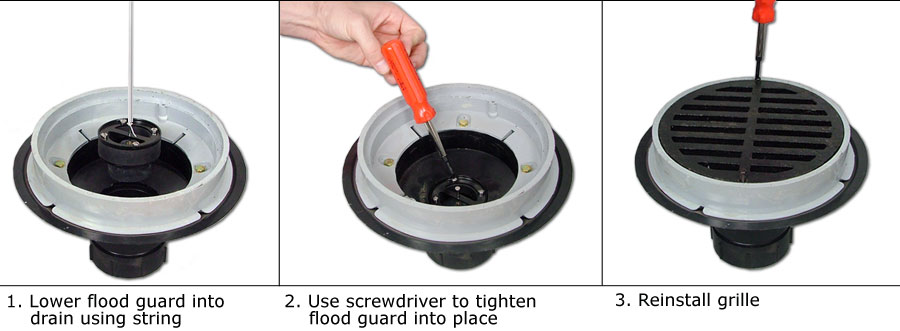
I found a "Flood Guard for Floor Drains" on PlumbingSupply.com.


The company has a wide range of products from water damage prevention to FloodStop systems. I have never ordered products from this company. If you have, I would love to hear what you thought about the company and their products!

Have you used any flood prevention products in your home or business? Built any barriers, or taken any steps to protect against flooding?

Please feel free to share your experiences in the comments section.

I'd love to hear about problems you have had with flooding and what you learned. What you went through may help someone else. That person might even be me someday!


08 April 2013

How To Prepare For Tornado Season

Well, tornado season is truly upon us. As I type this blog post people out in the Plains are preparing for possible tornadoes from a storm coming out of the Rocky Mountains tomorrow. So, perhaps it is time to discuss how to prepare your household for a tornado.

How To Prepare For Tornado Season

  • Prepare your yard by having any dangerous trees or tree limbs removed.
  • Build a safety kit - check out FEMA's Build a Kit page!
    • Food
    • Water
    • Battery-powered or crank radio
    • Flashlight and batteries
    • First-Aid kit
    • Whistle
    • Dust mask, plastic sheeting, and duct tape
    • Moist towelettes, garbage bags, and twist ties
    • Wrench or pliers
    • Can opener
    • Maps
    • Cell phone and charger
    • See website for more information
  • Have a tornado safety plan:
    • Pick the safest room in your house that all family members and pets will go to when a tornado may be coming. The best place is in a storm cellar or basement. If you don't have either option, then pick a room toward the center of your house, on the lowest floor, without doors or windows. 
    • Mobile homes are not safe! If you have time, go to a shelter or the closest sturdy building. Plan your possible safe places ahead of time.
    • FEMA's Ready.gov has a template that makes it very easy for you to create your own family emergency plan. I am going to make one for my home!
  • Practice tornado drills so that everyone knows how to react to an approaching storm.
  • Consider building a safe room.
    • This room could be in the basement, the garage, or in a first-floor room in your house.
    • There is a lot more information at the Ready.gov website under the "Preparing a Safe Room" tab. This includes a pamphlet and a manual for those of you who may be interested in taking this precaution.
  • Know if your community has a tornado siren and what it sounds like.
  • When you hear reports of a storm coming, make sure you store away loose items like yard/patio furniture and toys. If you can't move the item indoors then make sure you tie it down and secure it as well as you can.
Here are the two sites I used to gather information. As you can see, I color-coded them for you! There is so much more information at both these sites, so please check them out, especially if you live in a tornado-prone area!

American Red Cross: Tornado
FEMA's Ready.gov: Tornadoes

Being prepared for an extreme event, like a tornado, can mean the difference between life and death. Make sure you and the members of your household are prepared and knowledgeable. And of course, don't take any unnecessary risks! 

Stay safe this tornado season! I want you and your home to be around to prepare for the next tornado season, and the season after that, and the season after that, and the season after that...