Translate

Showing posts with label Dr. Heidi Cullen. Show all posts

22 April 2013

The Story of the Carbon Cycle

In honor of Earth Day I thought today I would tell you the story of the carbon cycle.


Many many many years ago, back to the time of the dinosaurs. Wait, go even farther back than that! Volcanoes were erupting and sending carbon dioxide (CO2) into the air. It was launched way up into the atmosphere, and there it stayed.


It was just floating along when all of a sudden it started to rain! All these drops of water started to fall from the sky and the CO2 thought that looked like great fun!

So, CO2 decided to hitch a ride with one of the raindrops. As they plummeted together toward the ground, the water and the CO2 decided to become best friends forever. They called themselves carbonic acid.


They weren't a very strong acid, but they sure did know how to party with the rocks! The stones that the carbonic acid landed on were glad for the new company and reacted by releasing carbon. The carbon from the carbonic acid rock party washed gently into the ocean. There it meet other carbon that had eventually found its way to the ocean too. Some carbon took a longer route to get there, but all carbon ends up in the sea!


Our carbon had seen how much fun the water, CO2, and rocks had together and wanted a friend of its own!

Unfortunately, the carbon started acting out and upset some nearby plankton. The plankton decided it was best to lock the carbon up in it's shell so it wouldn't cause anymore trouble.

The carbon and the plankton lived together until the end of the plankton's life. When the plankton died it drifted to the bottom of the ocean and eventually became a rock. The carbon now found itself back inside the Earth.


Another CO2, cousin to our first friend, found the temperature becoming warmer and warmer and all her friends were joining up with rain droplets. She watched as more and more carbonic acid dropped down and made the rocks release more carbon. As it grew hotter she started to get worried.


But then the plants started to grow and grow. They liked the rain, the warm temperatures, and our friend CO2. This little CO2 decided that the party life wasn't for her and joined up with a plant instead. The plant pulled her in and placed the carbon into the soil, back to the ground where she started.


The temperature started to even back out again as the amount of carbon in the air was brought back into balance.

Every now and then something would happen that would make the Earth cooler or warmer, but eventually the carbons working with the rocks and the plants would balance out the climate.

Well, until man arrived and started to invent new and amazing things.


Most of the carbon ended up in the ground in forms that man learned to use, like oil, coal, and natural gas.

All of a sudden, carbon that had slept for thousands of years was waking up!

Carbon had slept for so long in a rock at the bottom of the ocean, but what was that noise?! The carbon that had gone into the ocean floor because of plankton was now being drilled back up!

His cousin had ended up as coal deep in the ground and had slept soundly too, but now she was being dug up as well!

As the coal was burned and the oil was burned, our cousin carbons were released back up into the air! Along with their other cousin carbons that hadn't been up there for centuries!

As they gathered together they remembered the fun they had all those years ago, and again joined up with water. It came raining back down as carbonic acid and the cycled continued as it had all these years. Except now there was more carbon being released by man and less trees and vegetation to pull the carbon back into the ground. Man threw more and more carbon up into the sky, not considering what it might do to the delicate balancing act billions of years in the making.

It's getting warmer. 


Earth will be alright, she will make it through this carbon party and eventually balance herself back out.

The question is, can we adapt to the changes we are causing? Can we survive long enough to see the climate come back to its balanced state?

I hope so.


(This story was written using information gathered from The Weather of the Future by Dr. Heidi Cullen. This information can be found in Chapter 2: Seeing Climate Change in Our Past on pages 23-25.)

18 February 2013

Guaranteed to Keep You Up at Night...

When I was a kid I always thought the weather was pretty cool. I especially loved learning about lightning at the Museum of Science in Boston, MA. I never considered weather more seriously though, and wasn't even really paying attention to the issue of climate change.

All that changed in August of 2010.

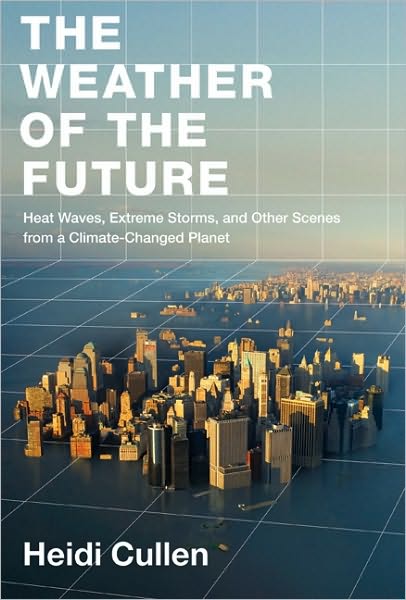
At that time, what I WAS into was, The Colbert Report.  One night that August, Stephen Colbert had a woman come on the show to talk about her new book.  Her name was Dr. Heidi Cullen and her book was, The Weather of the Future: Heat Waves, Extreme Storms, and Other Scenes from a Climate-Changed Planet


After listening to her short interview I knew I HAD to read her book!


Dr. Cullen was smart, funny, and not only knowledgeable, but able to talk to non-weather people (like you and me), and not leave us going, "uhhhhhh, whaaat?"

Her book made it to my Christmas list that year, but once again, Santa let me down.  I ended up buying it for myself, and had no buyers-remorse.  It was an excellent read.

Dr. Heidi Cullen is a research scientist for a nonprofit organization called, Climate Central.  They actually have some great videos on their site. I have already borrowed one for a previous post, and will definitely be using more in the future.  Dr. Cullen has worked for The Weather Channel, lectures at Princeton, is a member of the American Meteorological Society, has spoken on all sorts of television programs, and my favorite tidbit, lives in Princeton, NJ! All of this information can be found on the back cover of her book.

Her book focuses on climate, climate change, and the possible future of our planet and weather.  She does an exceptional job of explaining what climate change is and how it works.  I did not take any physics or chemistry classes in college, am absolutely horrid at math, and yet I was able to understand the concepts in this book. Not only did I understand the book, but I enjoyed reading it as well!

I certainly can't say that about all the non-fiction books I have read, or have tried to read.

The second part of her book was a look at weather predictions around the world.  One that really stuck with me was about The Great Barrier Reef (GBR) in Australia.


As it turns out the GBR and its beautiful corals are very sensitive to temperature and the acidity of the ocean water.  When the water gets too warm, and it doesn't even have to be that much warmer, the algae that lives in the coral leaves and takes all those gorgeous colors with it. Now you only see the white of the coral itself.  The coral then weakens and can die, because not only does the algae provide colors but also nutrients.  This is called coral bleaching.


The book explains so much more than what that video covers.  Dr. Cullen talks to scientists working with the GBR, and explains how they are working to protect this treasure.  She also predicts what could occur if climate change continues unchecked.

For those of you more interested in issues closer to home she also covers Central Valley in California and New York, New York.  The book was published in 2010 and she actually made this prediction for September 2013, "And in September 2013, with the Yankees not even looking to play in the postseason, the Atlantic Ocean reawakened and one specific hurricane seemed to be in a New York state of mind."

Hmmm, Superstorm Sandy, October 2012? Sure, she was off by little over a year, and her storm was Category 3 Hurricane Homer, but she did predict the flooding.  She even states in her book, "managed to flood the subway as well as the PATH train systems at the station in Hoboken, New Jersey, shutting down these transportation systems for almost a week."  Pretty eerie.  Not all her predictions are worst-case scenario though.  She has NYC learn from the storms and adapt by building storm-surge barriers, raised airport runways, re-zoned coastal areas, and so forth.

Dr. Cullen has been referred to as an alarmist, but honestly, sometimes we need to hear about the worst that could happen.  Will all these tragic predictions come true? Will the coral reefs die, the ice caps melt, and many more plants and animals become extinct? Possibly. We need to be aware of all predicted outcomes, and understand all the possible consequences of our actions.  This book instructs, and opens your mind to possibilities we many not want to consider, but should.

After flipping through the book again to write this post, and looking at the different predictions, I think I am going to give it another read! I highly recommend that you give this book a try too.