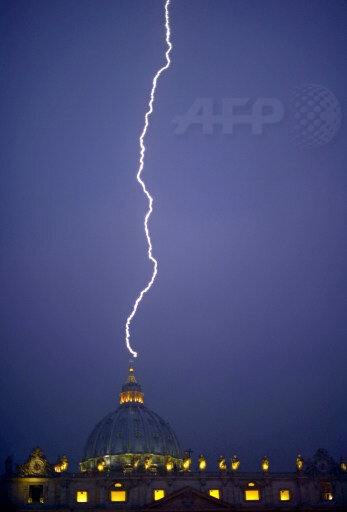
In my area we didn't have anything as severe as a tornado, but we did have our first thunderstorms of the season. As I lay in bed listening to the thunder, I decided it was a perfect time to write a post about thunderstorms.
I had touched a bit on lightning in my post When Lightning Strikes the Vatican and now I would like to expand on the topic.
I found some great information on NOAA's National Severe Storms Laboratory website.
First, let's explore how a thunderstorm is created.
It starts with the sun heating the Earth's surface, which in turn warms the air above that part of the ground. Something then has to "bump" the air and cause it to start to rise. According to the site, this could be other colder or wetter air, mountains or hills. If this rising air remains warmer and lighter than the air around it, it will continue rising.
As the warm air rises up into the atmosphere "the water vapor it contains begins to cool, releases the heat, condenses and forms a cloud".
 |
| Weatherquestions.com |
That wasn't too hard! But, how does this end? I mean, thunderstorms don't last forever, so when does it stop and dissipate?
Thunderstorms have three stages to their lives, developing, mature, and dissipating. We have already covered the first two stages so lets take a look at the third.
During the mature part of the storm the warm air from the ground is still rising up into the cloud and pushing water vapor into the freezing air. As long as the air keeps rising the storm keeps going. Eventually, all the precipitation and wind coming down from the cloud overpowers the warm air rising up. The supply of new water stops and the precipitation raining down will slow and stop. Just be aware, even though the rain has stopped the lightning can continue for awhile.
 |
| Photo from NOAA NSSL:Severe Weather 101 |
Once again, NOAA's National Severe Storms Laboratory has an excellent site with all sorts of information about lightning.

You know those little jagged pictures of lightning that we drew as children?
Turns out that lightning really is jagged! "Lightning is a channel of electrical charge called a stepped leader that zigzags downward in roughly 50-yard segments in a forked pattern."
Or course, we can't actually see it, so our drawings weren't exactly accurate, but it's still pretty neat!
I thought this was cool too. "As it nears the ground, the charged step leader is attracted to a channel of opposite charge reaching up, a streamer, normally through something tall, such as a tree, house, or telephone pole."
It is when these two meet, the bolt and the streamer, that the current starts surging. I had mentioned in my previous post about lightning that the current goes through the lightning bolt multiple times. This is because when the two meet, a backlash of current actually travels back UP toward the cloud! One bolt can send up to twenty return strokes giving the bolt the appearance of flashing. Below is a short video from National Geographic on the topic.
This video doesn't mention ice particles causing the electrical charge, but it does explain the separation of the charges and the resulting release in the form of lightning.
So, what about thunder? Lightning causes thunder, so if you hear thunder you can be certain that somewhere there was lightning!
A lightning bolt heats the air around it, and heated air expands. It is so hot, and the air expands so quickly that it causes a sound wave, and that is what we hear.
Have you ever noticed that when the storm is close enough you can actually hear three distinct sounds in the thunder? First, there is a tearing sound as the lightning rips down through the sky. Then a sharp cracking sound caused by the streamer reaching up from the ground, followed by the rolling boom of thunder, which is what we hear when farther away.
This all happens very quickly so don't feel bad if you don't know what I am talking about. I have spent a lot of hours just sitting and listening to storms. It was actually a favorite activity in my family! Most people will be able to at least identify the crack and then the boom.
I think thunderstorms are amazing and are one of my favorite weather events. I love listening to them and watching them whenever possible. I will admit that I probably take too many risks when it comes to thunderstorms, but I just can't help it!
On that note, lightning safety is very important, and therefore, needs a post of its own. So, please check back soon for tips on thunderstorm safety!